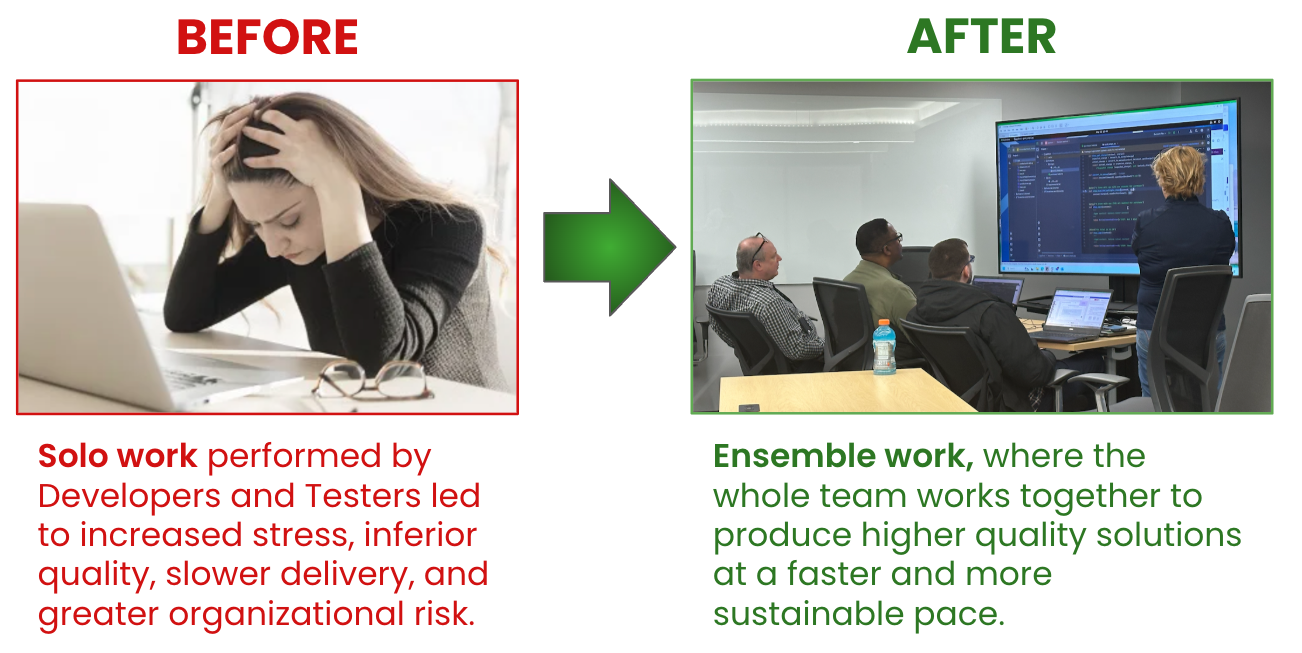



The Industrial Logic coaches guided the team in ensemble programming which fostered collaboration, collective responsibility, improved quality, lower WIP, and decreased cycle time.

Across the highest levels of government, the mandate is clear: the U.S. Army must accelerate its digital modernization. Senior leaders—from Secretary Hegseth to the Army’s top software and acquisition officials—are emphasizing that software now drives every major weapon system, business process, and training platform. This urgency has led to sweeping policy actions, including Army Directive 2024-02 and the broader Acquisition Transformation Strategy, both of which call for adopting agile, lean, and DevSecOps practices to deliver capability at the speed of relevance.
These initiatives acknowledge a fundamental challenge: decades-old, hardware-oriented processes cannot support the rapid, iterative software development required on modern battlefields. Current conflicts and emerging threats demonstrate that competitive advantage increasingly depends on the ability to update and deploy software quickly. In response, the Army is reforming core institutional processes—from acquisition and contracting to testing, cybersecurity, and talent development—to enable modern software practices and accelerate digital transformation across the force.
This case study will share how Industrial Logic is helping the U.S. Army Software Engineering Center (SEC) with their modernization effort.
The engagement began with an onsite assessment by our team of coaches, which unearthed the following challenges the teams are facing:
Insufficient Collaboration. Functionally-siloed project teams with part-time team membership inhibit flow.
Waterfall Thinking. Waterfall, phase-gated processes prevent the flow of work.
Insufficient Workflow Visualization. Work items stay in progress for weeks, months, or even years.
Burdensome Requirements Process. The true "Voice of the Customer" is often missing.
Over Specialization with Manual Processes. Testing relies too heavily on manual processes.
Lack of Quality-First Practices. The lack of technical and collaborative practices is hindering CI/CD adoption.
The Industrial Logic coaches guided the team in ensemble programming which fostered collaboration, collective responsibility, improved quality, lower WIP, and decreased cycle time.
The ensemble worked together to get a story finished with shared responsibility from start to finish. The members would help each other with tasks which may not be strictly theirs from a reporting structure. (i.e. Developers might help the tester’s test. Tester’s might research information needed for the Developers.)
We partnered with the team to create their first CI/CD pipeline—automating builds, tests, and artifact creation. More importantly, we coached them to own and extend the pipeline themselves, ensuring lasting improvement.
The Developers learned test-driven development, micro-testing, and refactoring.
They put together a set of instructions to properly configure their IDE to compile and run their system.
The product backlog was streamlined, old defects resolved, and unnecessary items removed.
Coached the ensembles to working only on small user stories which were on the order of 1-3-days, and tracked them on a Kanban board.
Because the legacy codebase was difficult to unit test, we applied the characterization testing technique using Approval Tests to enable the team to generate meaningful automated tests quickly. This approach established reliable test coverage where none existed before, dramatically reducing release risk.
changed the mindset
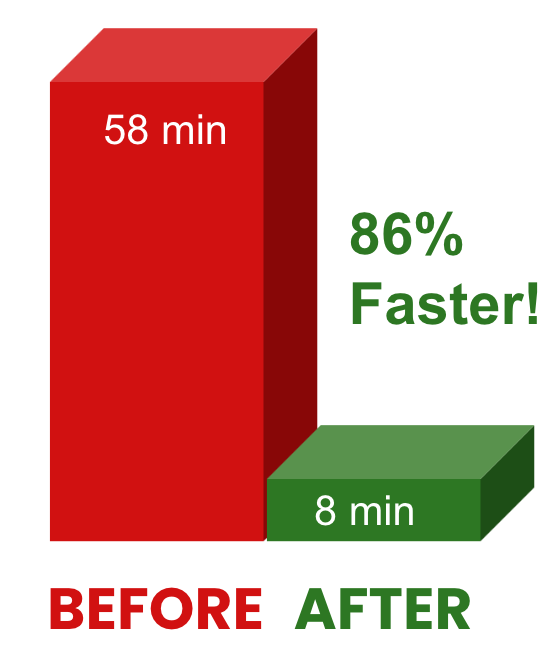
Improvement: As part of the DevSecOps pipeline implementation, the MRAP-IB ensemble worked to improve the performance of the “build step”. Previously the build often took nearly an hour to complete. By applying caching techniques and parallel execution, the team reduced the build time to just over 8 minutes.
Benefit: A faster build time speeds feedback, allowing developers to detect and fix issues quickly, boosting productivity and overall delivery speed.
“Our team loved what Industrial Logic helped us do. They trained and coached our staff to use a better, more repeatable way of developing quality software, which delivered far better results for our business.” Director, Systems Development, Kappa
Improvement: Scaled testing efforts by two orders of magnitude, establishing a robust safety net for legacy code.
TBD...